

7 key email metrics to track beyond opens and clicks

These lesser-known metrics will shed more light on whether your email program is thriving, surviving or ready for resuscitation.
How many email metrics do you and your email marketing team track to measure how your email program is performing?
The top five metrics marketers use to measure success — opens, clicks, unsubscribe, click to open and bounces — are all activity-based, the 2021 State of Email Analytics report from Litmus revealed.
Those metrics all have their uses, mainly as trend indicators. And the open rate, which was already an unreliable success metric, has become even more so since Apple launched its Mail Privacy Protection feature in 2021.
Several lesser-known metrics will shed more light on whether your email program is thriving, surviving or ready for resuscitation. Depending on your ESP and its built-in reporting, you can track these right in your dashboard.
The others will require some calculating and integration with other databases in your organization, or a third-party reporting tool can be very useful. But the extra effort will be worth your time and energy because you’ll understand better what’s going on.
1. Conversion rate
Depending on your ESP, this campaign-level metric might be reported in your dashboard. But even if you can view it there, take some time to calculate it on your own.
Why you should track it
When reviewing your metrics holistically, this metric will help you calculate your per-email-campaign success. You can use it to compare the success rates of email campaigns that target different-priced items.
How to calculate it
Take the number of conversions and divide it by the number of emails delivered (Note: Not the total number of emails sent).
Let’s say you sent 105 emails, and 100 were delivered. If 50 subscribers click on your website, and 25 of them convert, that works out to a 25% conversion rate.
What to know
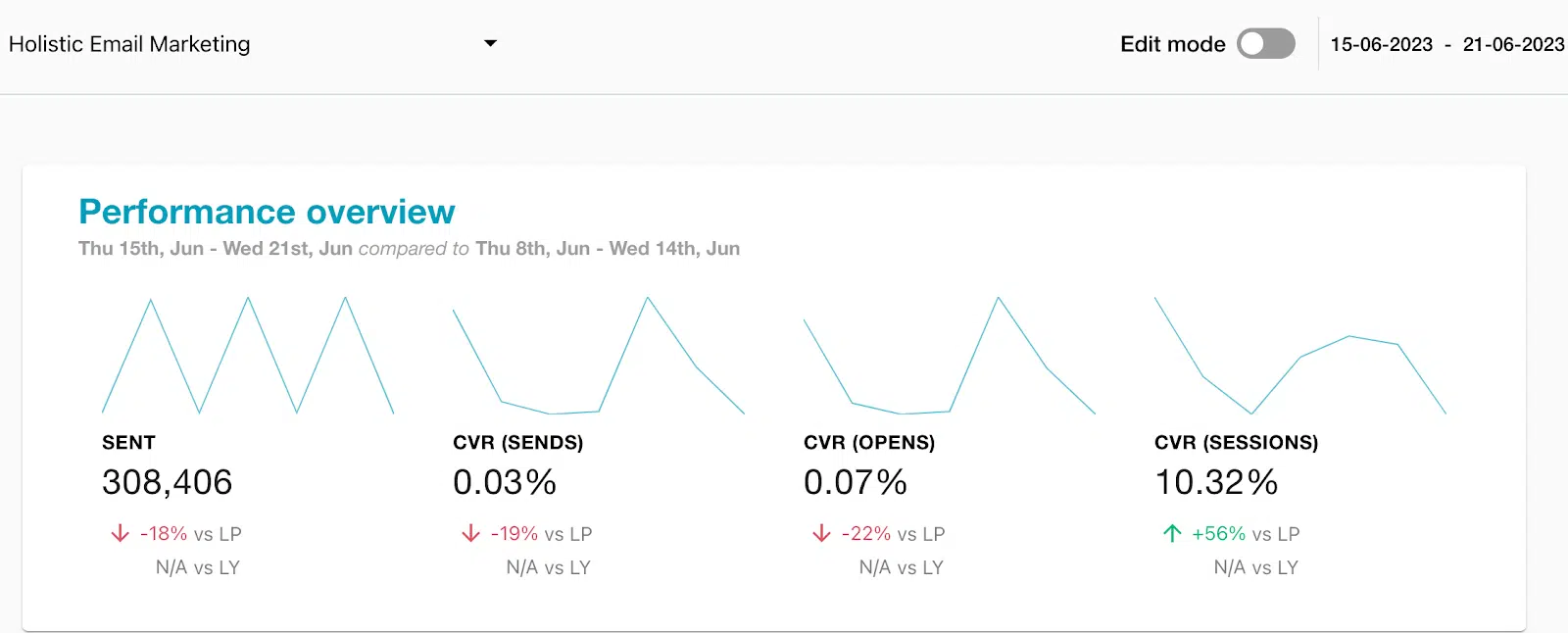
How you calculate conversion rate matters. Remember that Google Analytics uses landing page sessions to calculate conversions. Email marketers need to isolate email-related activity to find the actual conversion rate, which involves a larger number of metrics before customers get to the campaign’s landing page on your website.
If we were to calculate the conversion rate based on sessions, it would be 50%. That might look more impressive, but it doesn’t track back to your email. It’s the same number of conversions, just spread out over a much smaller field of possibilities.
Conversion is just one facet of the total email journey. If you focus only on website activity, you’re excluding engagement on other parts of the customer journey in which email plays a part. It could also lead you to optimize incorrectly or negate the impact of your email messages.
This reporting tool below showcases the different results for conversions, depending upon which calculation you use.
2. Value of an email address
This represents the monetary value of each email address in your database based on revenue from email. It is a business metric, not a campaign-level measurement.
Why you should track it
Unlike other metrics in this list, the value of an email address can help you make strategic and business decisions as well as campaign-level planning.
How to calculate it
Multiply the life of an address by annual email revenue and divide by the average list size in a year. For example, if the average life on your list is 3 years, your annual revenue from email is $700,000, and your annual list size is 95,000, the equation would look like this: 3 X $700,000 /95000 = $22
What to know
This metric illustrates why it’s so important to grow your email database. Here are two insights you can draw from this:
Reliable success metric
For example, suppose you want to increase frequency to increase revenue from email but are concerned that you could end up increasing unsubscribes or spam complaints from disgruntled subscribers.
While unsubs and spam complaints are one factor to consider, higher frequency can convert more subscribers to purchase, which in turn would increase revenue. Tracking email address value can reveal whether your subscribers respond with revenue or revolt.
Evaluate acquisition expenses
Knowing your email address value can guide your decisions on how much to spend on subscriber acquisition. The higher value, the more you can justify spending to attract higher-quality subscribers. If you don’t know your subscriber value, you could end up wasting your acquisition budget.
One note: This formula is more effective for B2C email marketing, especially retail and ecommerce. For B2B brands, the classic lead-nurturing process can make the value harder to determine.
3. Customer behavior beyond campaigns
This long-tail metric involves tracking campaign-level metrics beyond the immediate campaign time period. It helps you account for every bit of revenue from email and benefits your program in the long run.
Why you should track it
Because we usually have to move on so quickly to the next campaign, many marketers simply close out each campaign with a static report without going back a week or longer later. That’s a mistake because you likely will see some activity. If you keep tracking campaigns until you see no more activity, you could go months before you stop seeing conversions.
How to track it
Check your campaign activity regularly until you see no more activity. Automate this process through your reporting dashboard if you can, or send a manual reminder.
What to know
Most campaign reporting ends way too soon. But we know that customers often retain and act on emails days or weeks after you have moved on to a new campaign. That’s the long tail of email in action. Customers don’t always stop clicking after the campaign ends.
Email’s “nudge effect” explains this long-tail characteristic. Subscribers aren’t always in the market when your email campaigns arrive. If they’re engaged with your brand, they might keep your email in the inbox until they’re ready. Seeing your email can be enough to spur them to click and convert.
Up to 19% of consumers will save the email for later to take advantage of a discount, special offer or sale, DMA UK’s 2021 Consumer Email Tracking found. Although that number has been receding in recent years, it still points to a measurable source of revenue from email.
If you stop tracking activity too soon, you could be under-attributing revenue from email. One of my clients found it was under-recording email revenue by 128% when it expanded its reporting period from 4 days to 3 months.
Remember, the more revenue you can attribute to your email campaigns, the more budget you can request and justify to support your program.